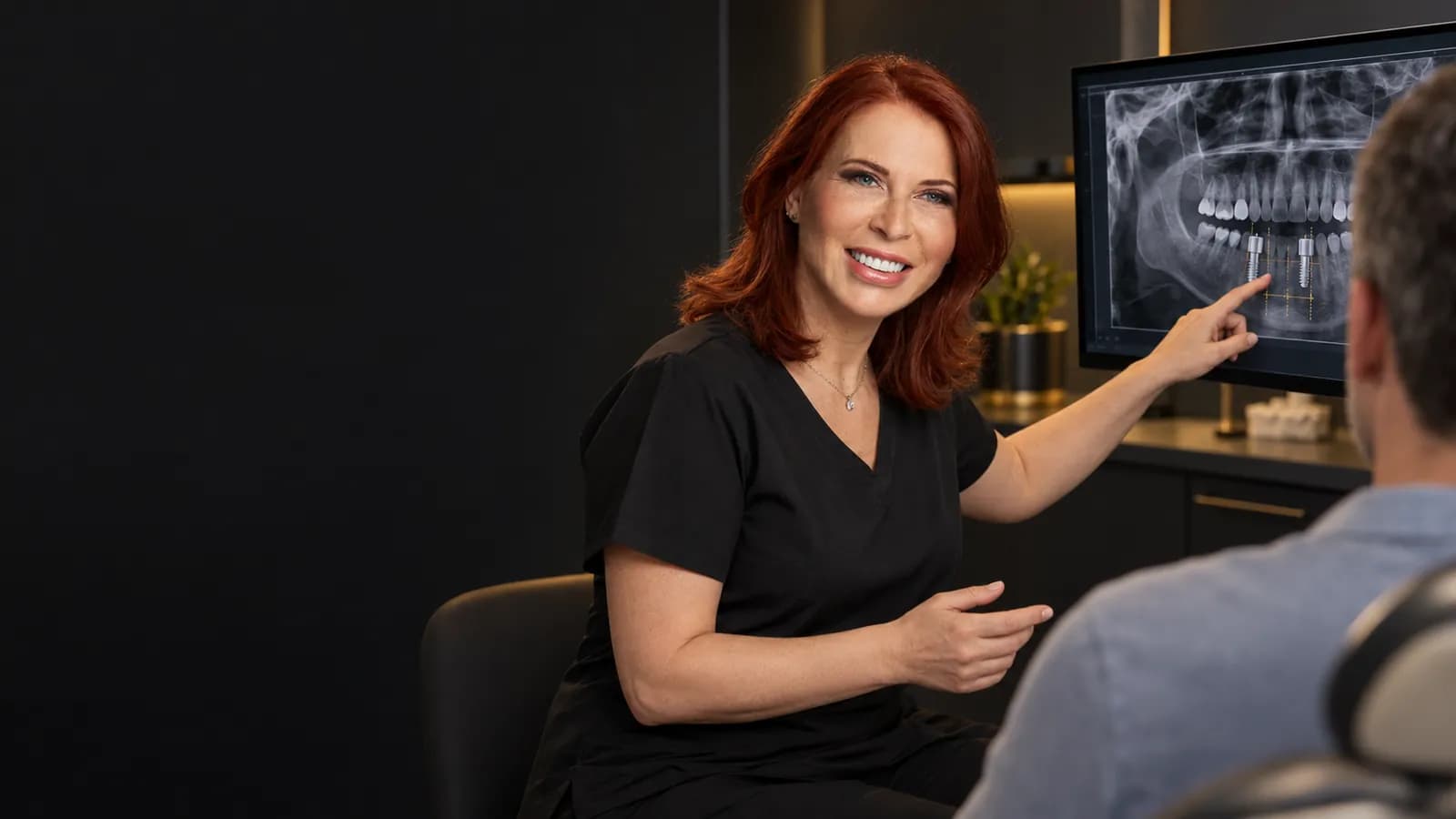
Have you received a plan for implants or complex dental work?Before you begin, understand all the options.
- 25+ years of experience
- Multidisciplinary team
- Implantology and digital prosthetics
Complex dental treatment means time, money and decisions that are made only once. If you have received a plan and still have questions, send it to us. A doctor from our team reads it and explains your clinical situation and the options you have.
It is common for the plan you received to be appropriate. When that is the case, we tell you just as clearly as when we see something different. A second opinion that confirms the plan is as valuable as one that suggests a different path — it gives you the reassurance of going ahead fully informed.
Send your plan for a second opinion
Your documents reach the medical team
Dr. Ada Epistatu
Founder of Smile by Ada (formerly Ada Dental Center). Senior consultant dentist, PhD in Medical Sciences, certified in implantology. Official DSD certification, Madrid.
How it works
You send us the plan
The treatment plan, the cost estimate or the X-ray — whatever you have to hand. The more you send, the more precise the opinion.
A doctor reads it
Not an algorithm. A doctor from our team looks at the documents and the images and determines what can be said remotely and what requires a consultation.
We talk it through
We call you within two working days and explain what we have understood about your situation, in words you can take with you anywhere.
What you receive
Your clinical situation, explained
What the images show, what it means for your teeth and why the order in which things are done matters.
The options that exist
There are usually several paths to the same result, with different costs and durations. You learn about all of them, not just one.
The questions worth asking
You leave with a concrete list of questions for the doctor who drew up your plan. A good plan stands up to questions.
An alternative treatment, where appropriate
If the documents show that there are other possibilities, we explain them to you. At your request, we can later draw up a complete plan at the clinic.
What we check, depending on what you have received
Each type of treatment has its own sensitive points. Open yours to see which documents help and what exactly a doctor looks at.
Dental implant
An implant often begins with an extraction, and an extraction cannot be undone. Before it happens, it is worth knowing whether the tooth could still have been kept and whether the number of implants proposed matches the final restoration.
What helps to send
- ·The treatment plan or cost estimate you received
- ·The panoramic X-ray (OPG)
- ·The CBCT scan, if you have had one — it shows the bone in three dimensions, not just in one plane
- ·Photographs of your teeth, if you have them
What the doctor looks at
Whether the tooth can still be saved
A tooth that has had root canal retreatment, or one with recoverable periodontal support, can stay in place for many years. We look at whether extraction is the only way out or simply the quickest.
Whether the available bone supports the plan
Bone volume and density decide whether the implant can be placed directly or whether grafting is needed. They are seen on a CBCT scan, not on a panoramic X-ray.
The position of the sinus and the nerve
In the upper jaw, the distance to the sinus matters; in the lower jaw, the path of the alveolar nerve. Both change the length and position of the implant.
The number of implants compared with the final restoration
How many implants the proposed restoration actually requires. Large differences between plans usually come from here, not from the price per implant.
The implant system and its traceability
Years from now you will need compatible components. A system with documentation and long-term availability matters more than it seems at the time of placement.
The stages and what the cost estimate includes
Immediate or delayed loading, a temporary restoration, the final restoration, maintenance. Many differences in cost are in fact differences in what is included.
Alternative paths that usually exist
- ·Keeping the tooth through endodontic or periodontal treatment
- ·A bridge on natural teeth, when the neighbouring teeth need to be covered anyway
- ·A partial denture, as an interim or a permanent solution
- ·Spreading the treatment over time, if budget is the main constraint
I was told the tooth has to be extracted. Can it really not be saved?
Sometimes it can, sometimes it cannot. It depends on how much bone support it still has, on the condition of the root and on what has already been tried. We look at the images and tell you what can be seen and what can only be established at a consultation.
Why does the number of implants differ so much between plans?
Because they start from different final restorations. A plan with fewer implants may be correct for one prosthetic design and insufficient for another. A comparison only makes sense for the same final result.
Do I need a bone graft?
This is determined from the CBCT scan. There are situations in which grafting is necessary, and others in which shorter or angled implants can be used. If you have the CBCT scan, send it — without it, the discussion remains an assumption.
All-on-4
All-on-4 means a full arch supported on four implants. When the indication is right, it works very well. Before the procedure, it is worth checking whether your situation fits and what exactly the cost estimate covers.
What helps to send
- ·The treatment plan or cost estimate you received
- ·CBCT — for All-on-4 it is the deciding document, not an extra
- ·The panoramic X-ray (OPG)
- ·Photographs of your smile and of your dental arches
What the doctor looks at
Whether four implants are enough in your case
It depends on the volume and quality of the bone, the shape of the arch and the chewing forces. The same restoration may be correct for one person and undersized for another.
The angle of the distal implants
The back implants are angled to avoid the sinus or the nerve and to widen the base of support. Their position decides how long the restoration can be.
Whether All-on-6 would be the more suitable indication
Two more implants change the distribution of forces and the long-term safety margin. It is not automatically better — but it is a question worth asking before, not after.
The temporary and the final restoration
“Fixed teeth in 24 hours” usually refers to the temporary restoration. What matters is when the final restoration comes, what material it is made of and whether it is included.
The material of the final restoration
Acrylic, composite and zirconia behave differently in terms of wear, repairs and over time. The price difference between plans often comes from here.
What maintenance includes
A restoration on implants needs specific check-ups and professional cleaning. If they do not appear in the plan, they appear later in the budget.
Alternative paths that usually exist
- ·All-on-6, when the bone and the forces require it
- ·Individual implants with segmented bridges
- ·An overdenture on attachments, removable for cleaning
- ·Staging: a temporary restoration now, the final restoration after stabilisation
All-on-4 or All-on-6? I have received different proposals.
Both are genuine solutions, and the choice depends on the available bone, the shape of the arch and your chewing forces. We look at the CBCT scan and explain what, in your case, tips the balance one way or the other.
Are “fixed teeth in 24 hours” realistic?
In many cases yes, but this usually means the temporary restoration, fixed immediately. The final restoration comes after healing. It is important to know which of the two is in the cost estimate.
Is the temporary restoration included in the price?
It varies from plan to plan, and it is one of the most common sources of misunderstanding. We check what exactly the cost estimate you received covers and what is left out.
All-on-6
Six implants on one arch mean more support and a different distribution of forces. The difference from a solution with four implants is not only one of price but one of indication — and it is worth understanding before the procedure.
What helps to send
- ·The treatment plan or cost estimate you received
- ·CBCT — it shows whether the bone supports six implants, and where
- ·The panoramic X-ray (OPG)
- ·Photographs of your smile and of your dental arches
What the doctor looks at
Why six and not four
Six implants are justified by the available bone, the length of the restoration and the chewing forces. If the reason is not clear in the plan, we clarify it.
How the implants are distributed along the arch
It is not only the number that matters but also where they are placed. A balanced distribution reduces the load on each individual implant.
Whether the bone supports the proposed position
In the back areas, the sinus and the bone height limit the options. Sometimes this is solved by angling the implants, sometimes by grafting.
The material and construction of the restoration
A longer restoration needs a framework that does not flex. The material and the reinforcement decide its lifespan more than the number of implants does.
The stages and the temporary restoration
When the temporary restoration is fitted, when the final restoration comes and what happens in between.
What the cost estimate includes in the long term
Check-ups, professional cleaning, possible relines. The real cost of a restoration shows over several years, not at the time of fitting.
Alternative paths that usually exist
- ·All-on-4, when the bone and the length of the restoration allow it
- ·Individual implants with segmented bridges, easier to repair section by section
- ·A combination by area: fixed where possible, removable where not
- ·Bone grafting, if it opens the way to a more stable solution
Is the difference from All-on-4 worth it?
It depends on the bone, the length of the restoration and how hard you bite. For some patients the difference is real; for others it does not change the result. We look at your images and explain which applies to you.
Can I move from All-on-4 to All-on-6 later?
Implants can sometimes be added, but the prosthetic restoration usually has to be remade. That is why the decision costs least when it is made at the start.
How long does a restoration like this last?
It depends on the material, oral hygiene and maintenance. No serious figure can be given without seeing the actual situation, and anyone who promises a fixed number without examining you should give you pause for thought.
Dental veneers
Veneers can transform a smile, but they usually involve an irreversible preparation of the tooth. Before any tooth is reshaped, it is worth knowing whether your concern is one of colour, position or shape — because the solutions differ.
What helps to send
- ·The treatment plan or cost estimate you received
- ·Photographs of your smile, from the front and from the side
- ·The panoramic X-ray (OPG)
- ·The mock-up or digital simulation, if one has been made for you
What the doctor looks at
Whether the concern really calls for veneers
Colour can sometimes be addressed by whitening, position by orthodontic alignment, shape by recontouring. A veneer is suitable when shape and appearance are at issue together.
How much tooth structure is sacrificed
The difference between a thin veneer and a crown is large and irreversible. We check what preparation the proposed plan involves.
The number of teeth included
How many teeth are part of your visible smile, and whether all of them need treatment or only some.
Your bite and bruxism
If you clench your teeth at night, veneers can crack. This is checked before, not after, and sometimes calls for a night guard in the plan.
The condition and contour of the gums
An uneven gum line shows more than the colour of the tooth. Sometimes it needs to be treated before the veneers.
The material and the aesthetic trial
Feldspathic porcelain, e.max and composite look and wear differently. A mock-up shows you the result before any tooth is reshaped.
Alternative paths that usually exist
- ·Professional whitening, when the concern is only colour
- ·Orthodontic alignment, when the concern is position
- ·Composite recontouring, reversible and less invasive
- ·Veneers only on the teeth that really need them, not on the whole visible area
How many teeth need to be prepared?
It depends on how much of your smile shows and on what exactly you want to change. With a plan that automatically includes all the front teeth, it is worth asking why.
Veneers or braces?
If the teeth are healthy but unevenly positioned, alignment preserves the enamel. Veneers hide the position; orthodontics corrects it. They are different decisions, with different consequences over time.
Will they look artificial?
It depends on the material, the thickness and the technician. A mock-up made beforehand shows you the result on your own teeth, without any irreversible work.
Bone grafting and sinus lift
Bone grafting and sinus lift are genuine, useful procedures, but they add time, cost and a surgical stage. In some situations they can be avoided by choosing a different type of implant or a different position — and it is worth checking this beforehand.
What helps to send
- ·The treatment plan or cost estimate you received
- ·CBCT — without it, any discussion of the bone remains an assumption
- ·The panoramic X-ray (OPG)
- ·The history of your extractions, if you know it
What the doctor looks at
How much bone you actually have
The height and width of the bone are measured on the CBCT scan, in millimetres. Every serious discussion about whether grafting is needed starts here.
Whether it can be avoided
Shorter implants, angled implants or a slightly different position sometimes solve the situation without a graft. Not always — but it is worth asking.
The type of procedure proposed
Internal or external sinus lift, guided bone regeneration, block graft. These are procedures of different extent, with different risks and healing times.
The material used
Your own bone, bone of animal origin or synthetic material. Each has different advantages, integration times and costs.
Healing times and staging
Months usually pass between the graft and the implant. The plan should state clearly how many stages there are and how long each one takes.
Risks explained beforehand
Every procedure of this kind has a failure rate and possible complications. A correct plan sets them out from the start.
Alternative paths that usually exist
- ·Shorter implants, when the remaining bone allows
- ·Angled implants that avoid the deficient area
- ·All-on-4 with angled distal implants, avoiding the sinus
- ·Postponing, with a stable temporary solution in the meantime
Do I really need a bone graft?
Sometimes yes, and then it is the best investment in the whole plan. At other times there are solutions that avoid the deficient area. The difference shows on the CBCT scan, in millimetres.
How long will it be before I can have the implant?
Generally a few months of healing between the graft and the implant, depending on the type of procedure and the material used. The plan should state explicitly how many stages there are.
Is it a painful procedure?
It is done under anaesthesia, and the discomfort afterwards varies with the extent of the procedure. What matters more is that the indication is correct — a necessary procedure is easier to accept than an avoidable one.
Send us your plan
Fill in the form and attach what you have: the treatment plan, the cost estimate you received or the X-ray. You do not need all of them — we start with what there is and tell you if anything else is needed.
Prefer another way?
Documents can also be sent on WhatsApp — many patients photograph the plan with their phone, which is the simplest way. And if you have questions before sending anything, call us.
Our team speaks English and French.
Frequently asked questions
Will you tell me that the plan I received is wrong?
We do not assess colleagues and we do not comment on another doctor's decisions. We look at your clinical situation and explain what we see and what options exist. Often the conclusion is that the plan you have is appropriate — and we tell you so just as clearly.
Do I have to come to the clinic?
The first stage is done on the documents. Some things, however, cannot be determined from images — the mobility of a tooth, the condition of the gums, the bite. If necessary, we tell you that a consultation is needed and exactly why.
What happens to my documents?
They reach the clinic encrypted and only the medical staff see them. We keep them for 12 months and then delete them — unless you become a patient, in which case they become part of your medical record. You can ask for them to be deleted at any time.
Am I obliged to continue treatment with you?
No. A second opinion is your right, provided for by Romanian Law 46/2003. You can take it back to your own dentist, go elsewhere or do nothing for the time being.
Which documents are useful?
The treatment plan or cost estimate, the panoramic X-ray, a CBCT scan if you have one, and photographs of your teeth. If you have only some of them, send what you have — we will tell you if anything else is needed.
The right to request and obtain another medical opinion is provided for by Article 11 of Romanian Law no. 46/2003 on patients' rights. The doctor who drew up your plan is obliged to make your medical documents available to you on request.